
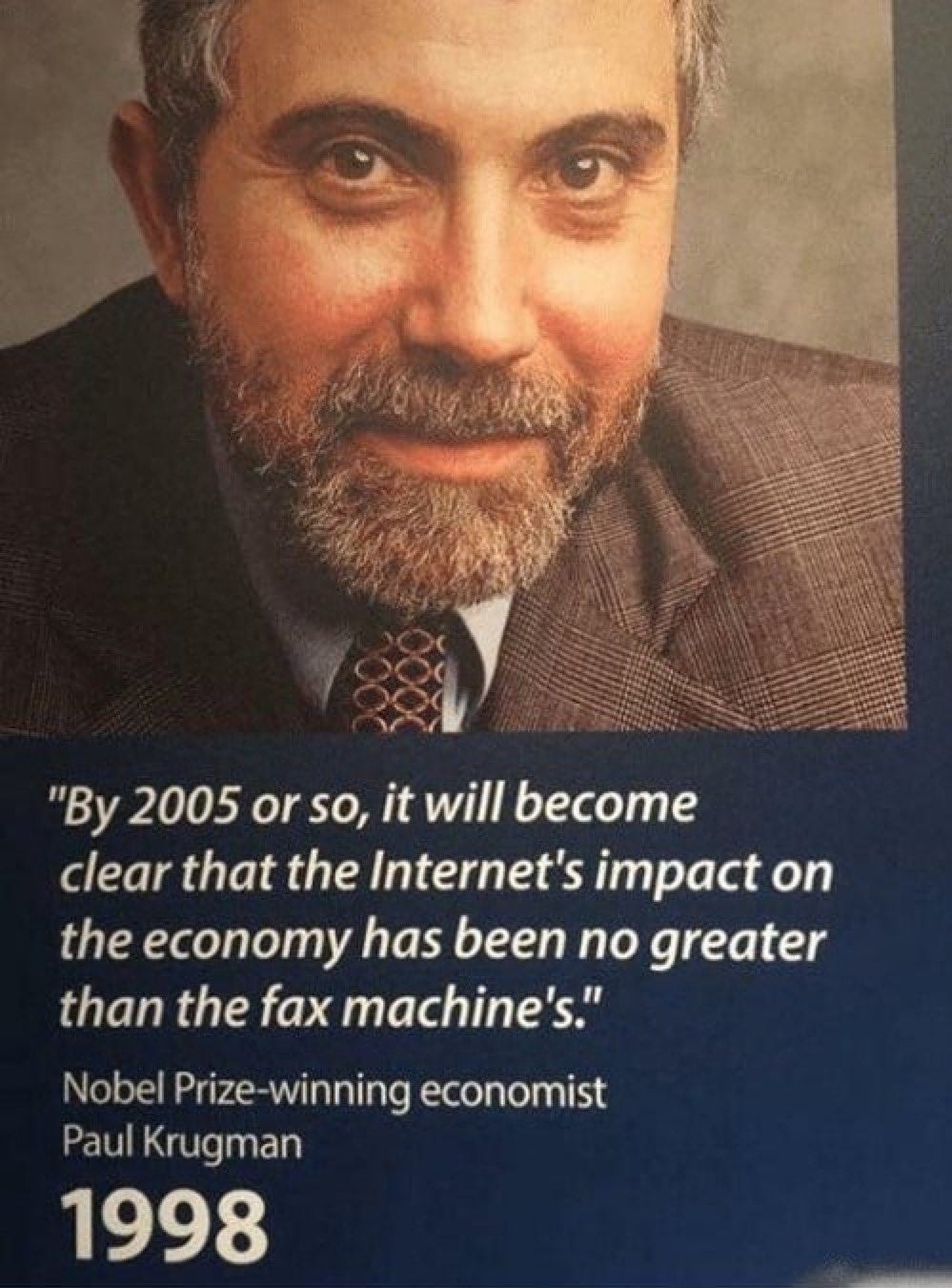
People who want more government control of healthcare often deride the U.S. system as “for-profit” or “capitalist.” They then blame its dysfunction on too much profit-seeking. Paul Krugman (famed soothsayer who once predicted that the internet’s economic impact would prove no greater than the fax machine’s) takes another approach. He admits that the U.S. healthcare system is already mostly socialist, describing it as a “partially privatized form of socialism.”
He’s right about the extent of government involvement. Michael Cannon, who is about as far from Krugman ideologically as you can get, states, “When it comes to government control of health spending, the United States is closer to communist Cuba (89%) than the average OECD nation (75%).”
But Krugman then treats that fact as an argument for moving further toward single-payer healthcare. Strange for someone who is so often critical of the U.S. system to want to double down on the very parts that make it so dysfunctional.
The fact that our dysfunctional system is “mostly socialist” suggests more socialization would make things worse. Krugman points out that the employer-sponsored insurance tax exclusion acts as a subsidy. It does—to the tune of about $471 billion in 2026. It’s also part of the reason care is so expensive. The culprit: government. The same entity also created demand subsidies such as the ACA marketplace premium tax credits and, even worse, an open-ended defined-benefit, fee-for-service program whose benefit spending is mandatory rather than fixed through annual appropriations: Medicare. That same government then implemented supply restrictions, such as restrictions on new and expanding physician-owned hospitals.
Krugman places most of the blame for the system’s dysfunction on its private component. But he also acknowledges that the government both subsidizes and regulates much of that component. He objects to Medicare Advantage plans receiving so much money, but Medicare itself sets and makes those payments.
Krugman also leans into the tired trope that private insurance creates all the administrative burden for doctors. I’ve argued before that Medicare’s low administrative-cost figures are misleading. Krugman also glides past the lived reality of physicians whose lives are micromanaged by Medicare rules. CMS establishes detailed documentation and coding requirements, determines which services are billable, and sets prices for more than 10,000 physician services. Medicare determines how time and medical decision-making translate into payment and how procedures are valued relative to cognitive care. Those burdens do not originate with private insurance.
The fact that we already have a largely socialized system also does not support Krugman’s claim that moving to single payer is a small step. The current House Medicare for All legislation would prohibit private insurance and employer plans from duplicating the federal program’s benefits, while allowing supplemental coverage for services the program does not cover. It would also eliminate all cost sharing and utilization management. Imagine taking SNAP benefits, making them unlimited, and giving them to every person in the country.
This is not a small step from a “mostly socialized” system into Medicare for All. That’s a fire hydrant’s worth of demand subsidies on top of an already constrained system.
A broad national defined-benefit plan with nationwide choice among qualified participating providers must have some form of cost control. Medicare for All legislation acknowledges this explicitly through a national health budget and even more micromanagement of doctors and hospitals. So legislators get to decide whether to constrain payments and supply, raise substantially more revenue, or blow an even bigger hole in the gross federal debt, already above $40 trillion.
Krugman, like many Medicare for All advocates, also ignores the variety of universal-coverage systems worldwide. Germany uses competing private insurance plans; Switzerland has no national public insurer for basic coverage, instead requiring residents to choose among private insurers. Singapore uses cash pay for most elective services paired with health savings accounts. Australia encourages private coverage so effectively that more than half of Aussies have it.
So Krugman may have stumbled onto the correct observation: U.S. healthcare is already largely government-financed and government-controlled. But that observation conflates cause and effect, like a doctor who ignores the underlying infection, thinking the fever is the only problem. Government sets the rules that structure our current healthcare system. We shouldn’t let it have even more control.
I lean toward the Singapore model with a generous safety net. I would layer an income-based deductible on top of the safety net to add some skin for the insured.
🙌