
It’s 7 p.m. I’m finishing dinner with my family and getting ready to help put the kids to bed. I’m looking forward to finishing a book with my daughter and playing a game with my son.
My phone goes off.
I’m on call. A 29-year-old has been in a car accident. He has a devastating traumatic brain injury and a large clot compressing his brain.
I drive to the hospital. We get him to the operating room. I remove part of his skull and evacuate the clot. His brain is badly bruised and swelling, so I leave the bone flap off. That operation, called a decompressive hemicraniectomy, can save a life by giving the brain room to swell outward rather than being crushed inward by the skull.
Then I place monitors. I insert a catheter into the fluid-filled spaces of the brain so we can measure intracranial pressure in real time and drain cerebrospinal fluid if needed. I place another probe to monitor brain oxygenation. Those monitors are connected to specialized equipment, and the patient heads to the ICU.
By the time I’ve stabilized the pressure, reviewed the scans, spoken with the ICU team, and had the first of many difficult conversations with the family, it’s well past midnight.
The next morning I’m back early to check on him. Then I do it again the next day. And the next.
For nearly two weeks, I spend substantial time at the bedside. I review serial CT scans. I manage external ventricular drainage. I interpret intracranial pressure trends and brain oxygen data. I coordinate with intensivists and trauma surgeons. I talk to the family every day about prognosis, goals, and setbacks. I make repeated decisions that can determine whether this patient recovers, remains severely disabled, or dies.
This is not some exotic edge case. Patients with severe traumatic brain injury who undergo decompressive craniectomy often have prolonged ICU stays, and published cohorts report ICU lengths of stay in the low teens for these patients. One recent clinical profile of acute TBI patients reported a median ICU stay of 13 days for decompressive craniectomy patients.
Now for the crazy part.
Financially, it would make more sense for me to do the surgery for free.
Under Medicare, most major operations carry a 90-day “global period.” That means the surgeon’s postoperative care is considered bundled into the payment for the operation. The Centers for Medicare & Medicaid Services (CMS) gives one fee for the entire thing: surgery, ICU care, non-ICU hospital care, and clinic visits for 90 days. In plain English: the surgeon does the operation, helps manage the patient afterward, but usually cannot bill separately for that postoperative work.
Most insurance companies follow CMS’s rules. They also use a universal language of codes, called CPT, to bill procedures, and they pay by converting the Relative Value Units (RVUs) of those codes to dollars.
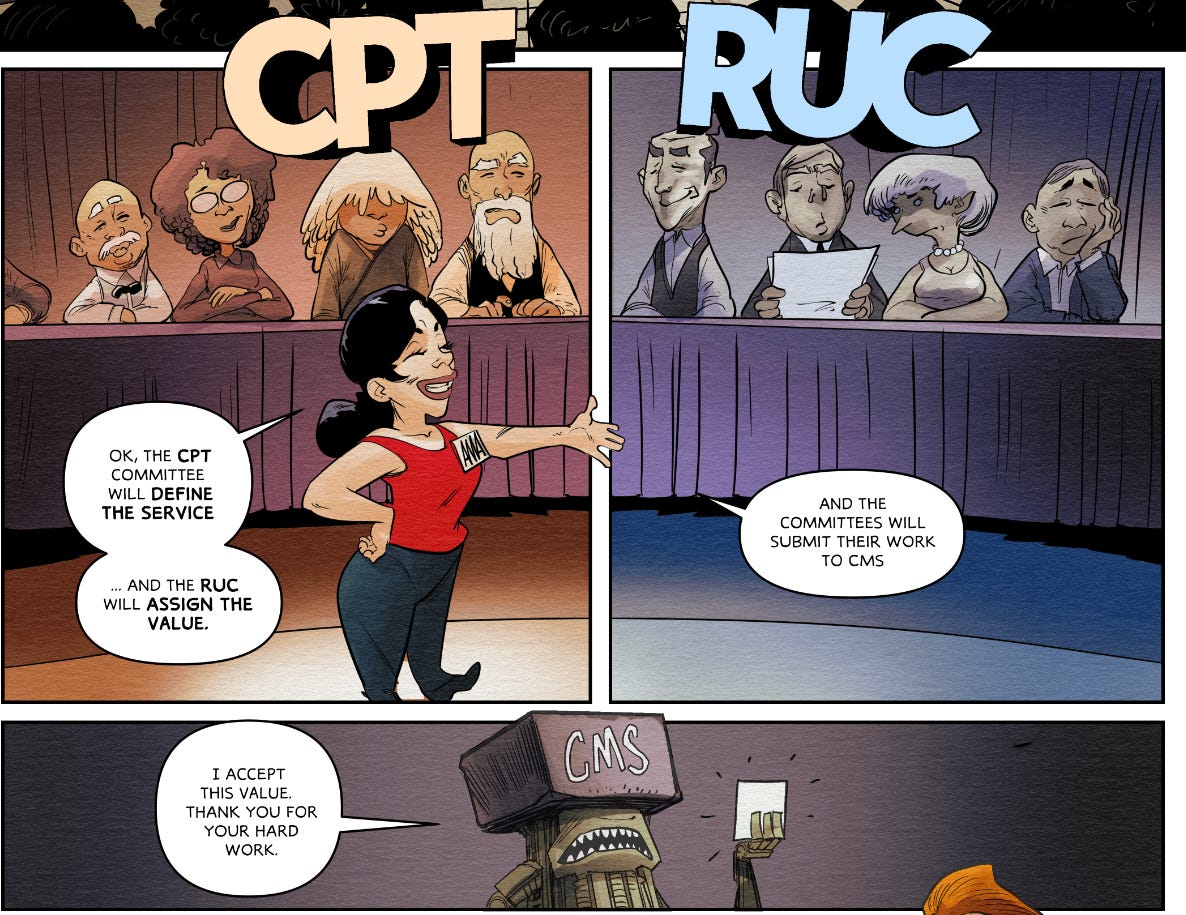
In 2026, a decompressive craniectomy billed as CPT 61322 generates 33.40 work RVUs and 68.97 total RVUs. The total RVUs are to cover the “overhead” of the physician’s office, such as staff, rent, utilities, etc. By contrast, CPT 99291, the first 30 to 74 minutes of critical care on a given day, generates 4.50 work RVUs and 5.96 total RVUs.
Do the math over a 13-day ICU stay.
So, if I could bill one unit of critical care each day that would total 58.50 work RVUs and 77.48 total RVUs. In other words, the ICU management would generate more value in Medicare’s arithmetic than the surgery itself. The work RVU breakeven happens after about eight ICU days. The total RVU breakeven happens after about twelve. By day thirteen, the ICU time has overtaken the surgery on both measures.
That does not mean I can simply skip billing the surgery and bill daily critical care instead. That is exactly the absurdity. The system has evolved to the point where it signals that the prolonged management around the surgery is worth more than the surgery, while simultaneously bundling that management into the operation so the surgeon usually cannot bill for it separately.
This is the downstream effect of years of federal tinkering with physician reimbursement.
Most recently, CMS finalized a 2026 “efficiency adjustment” that reduced work RVUs for many non-time-based services, such as surgeries. Time-based services, office visits, non-surgical inpatient care, and critical care, got a corresponding increase in reimbursement. CMS also changed the facility practice expense methodology, reducing the practice-expense component for many hospital-based services. So a hospital-based operation like decompressive craniectomy gets squeezed from two directions at once: on the procedural side and on the facility practice-expense side.
This did not come out of nowhere. It is the product of years of increasing valuation for time-based evaluation and management services combined with repeated downward pressure on many procedural codes. The 2026 rule simply made the distortion easier to see.
To be clear, this is not an argument that critical care physicians are overpaid. It is not. ICU care is hard, essential work, and my critical care colleagues absolutely deserve to be paid for what they do.
The point is that the whole structure is arbitrary.
Medicare does not discover prices. It sets them prospectively. Bureaucrats, committees, and formulas assign values to services in advance using estimates about time, effort, practice expense, and malpractice cost. The system tries to infer value from inputs.
That sounds technical and scientific. It is not.
It is a modern version of the old labor-centered idea, typically attributed to Karl Marx, that value can be derived from the amount of effort, time, and resources that go into producing something. Economists such as Mises and Hayek argued instead that value is subjective. Something has value because human beings value it, not because a planner has measured the inputs that went into it.
That matters here.
A bottle of water is worth very little to someone with potable water in their plumbing and a great deal to someone stranded in the desert. A guaranteed neurosurgeon available at 2 a.m. may look extravagantly expensive on a spreadsheet right up until it is your loved one lying unconscious after a car wreck. A community might balk at paying a neurosurgeon an enormous monthly standby fee for trauma call, but there is some number at which that community would absolutely decide the coverage is worth it. The value was always there. The question is how people choose to express it.
Medicine complicates this, of course. A patient with a life-threatening brain injury cannot bargain over a hemicraniectomy the way someone shops for a television. But subjective value does not disappear just because the situation is urgent. It moves upstream. People can still express preferences through the insurance they choose, the networks they are willing to pay for, the taxes a community is willing to support for trauma capacity, the hospitals employers want in a narrow network, and the many routine and semi-shoppable services that make up much of health care. Even in emergency care, the community’s willingness to support standby capacity reflects subjective value.
The problem with Medicare’s pricing system is not merely that it is government-run. The deeper problem is that it mistakes accounting for value. It assumes that if enough experts measure enough inputs, they can derive a correct price from above.
But they cannot.
The result is often incoherent. A payment system can end up signaling that thirteen days of ICU management are worth more than a life-saving middle-of-the-night decompressive craniectomy, while also refusing to pay the surgeon separately for that management because it is bundled into the global period.
Those payment rules shape behavior.
When postoperative ICU management is bundled into the surgeon’s fee but can be separately billable for another physician who did not perform the operation, the system nudges hospitals toward fragmentation. The surgeon may still round and oversee the broad surgical plan, but there is less financial reason to remain deeply involved in the granular ICU care. A separate neurocritical care team, appropriately or not, becomes the primary day-to-day manager and collects the billable critical care time.
This shows how Medicare helped create an entire new field of neuro critical care. There were other factors, but the payment structure clearly reinforces that division of labor. If you underpay surgeon involvement in the ICU and separately reward someone else’s time there, you should not be surprised when care becomes more fragmented.
That fragmentation may sometimes be appropriate. But it should not be dictated by a reimbursement quirk.
Payment systems are not neutral. They are signals. And the signal here is unmistakable: the operation, the technical skill, the call burden, the disruption of family life, the legal liability, and the responsibility of taking ownership of a crashing trauma patient are all worth less, in Medicare’s arithmetic, than the daily ICU time around the case. Then, in a final twist, the surgeon is told he cannot bill that ICU time anyway because it is already bundled into the operation.
That is central planning at its most revealing: a bureaucracy imposing values from above and then acting surprised when physicians and hospitals respond to the incentives it creates.
Over time, clinicians do what economics predicts they will do. They do less of what is undervalued and more of what is rewarded.
A system that makes it look financially rational for a neurosurgeon to do a middle-of-the-night hemicraniectomy “for free” is not measuring value. It’s dictating it.
I will use this in my nursing leadership class. Thank you