
In 2007, a 44-year-old man underwent elective spine surgery at a small physician-owned hospital in Texas. He developed respiratory arrest after surgery. Staff called 911, and he was transferred to another hospital, where he subsequently died. This tragic event has been misused by an argument published in MedPage Today to support federal restrictions that effectively prevent the development of new Medicare-participating physician-owned hospitals and significantly restrict the expansion of those that currently exist.
Those of us who work in hospitals see institutions fail to protect patients for a multitude of reasons, including understaffing, inadequate equipment, and disconnected administration. Those problems, however, are not unique to physician-owned hospitals.
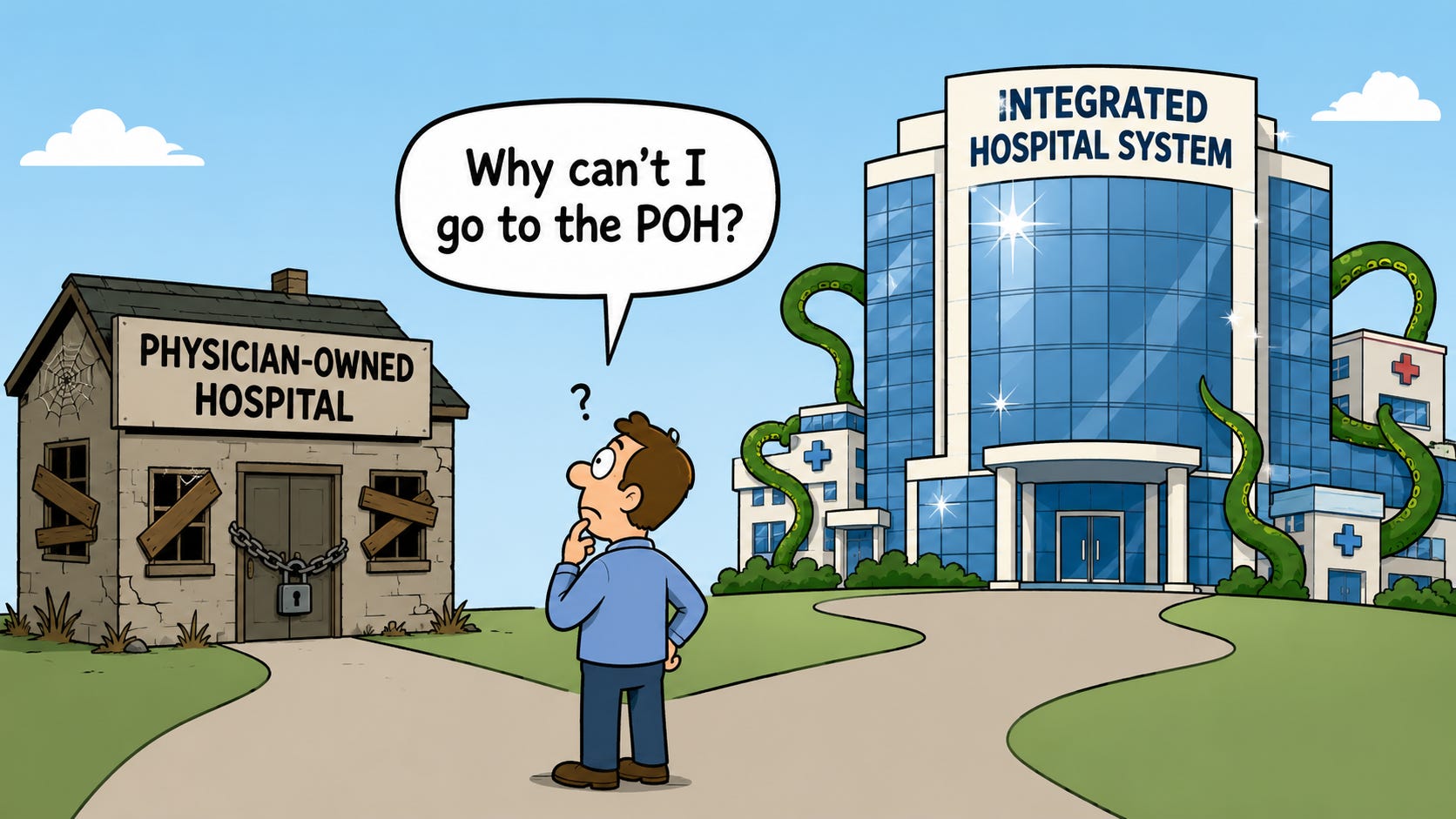
Yet physician-owned hospitals were effectively barred from new development under Medicare because opponents argued that physician ownership creates a unique set of financial incentives. Furthermore, they argued that these incentives cannot be replicated through other forms of ownership, including large vertically and horizontally integrated systems that may even offer their own insurance products.
The strongest evidence offered against physician-owned hospitals actually illustrates an important distinction. The Office of Inspector General’s 2008 evaluation reviewed data from 109 physician-owned specialty hospitals. It found that only 28 percent had a physician on site at all times and 66 percent reported utilizing 911 as part of their emergency response plans. However, the OIG also evaluated physician availability, registered-nurse coverage, and emergency stabilization and transfer capabilities. While 7 percent of the sampled days failed to meet these criteria, 93 percent met them.
As noted above, the OIG did not suggest physician ownership as a basis for exclusion from participation in Medicare. Instead, it recommended enforcement of the Conditions of Participation that already existed: ensuring physician availability, requiring a registered nurse to be present at all times, assuring that hospitals maintain sufficient capability to evaluate and initially treat emergencies, verifying policies for stabilization and transfer, and providing additional guidance for enforcing these conditions.
It is unrealistic to assume that every hospital will have the capability to treat every disease. For example, many community hospitals do not possess adequate neurosurgical capability to treat patients with intracranial hemorrhage and therefore must transfer them. That is why transfer arrangements exist. This is extremely common in non-physician-owned hospitals today.
A specialty surgical hospital should be held accountable to the same standard as any other hospital. If a hospital advertises itself as a full-service hospital, then it must meet the requirements of a full-service hospital. Many hospitals are not capable of treating every disease and should advertise themselves accordingly.
There is no doubt that physician ownership creates a financial incentive. Physicians may refer patients to a facility in which they have invested. A specialty hospital may favor patients who are well insured, healthy, and undergoing profitable procedures. Conversely, full-service hospitals bear costs for emergency preparedness, uncompensated care, and low-margin services that a limited-scope hospital does not bear. These are valid concerns.
Yet none is unique to physician-owned hospitals. Every vertically integrated hospital system operating in the country faces financial incentives.
The question, therefore, is what harms, if any, are sufficiently unique to physician ownership to warrant restricting this particular form of vertical integration while continuing to permit the others.
Large hospital systems decide which service lines to develop or eliminate, which sites to invest in, and which patients they are able to serve. Additionally, safety-net hospitals are disproportionately burdened by caring for large numbers of uninsured patients, complex patients, and patients who are otherwise unprofitable. We may not like admitting it, but certain groups of patients consistently produce negative margins, create substantial operational challenges, and can even generate significant security burdens.
Regardless of ownership type, hospitals still shut down service lines deemed unprofitable. A U.S. Senate inquiry into Bon Secours cited reports that the system closed the ICU at Richmond Community Hospital in 2017 and failed to replace several retiring specialists even as the hospital continued to generate substantial profits. The point is not simply that Bon Secours behaved egregiously. It is that, regardless of ownership structure, every hospital owner faces choices about which services are worth investing in based partly on profitability.
Safety-net providers receive subsidies for providing high-cost safety-net and standby care, and both physician-owned and non-physician-owned hospitals providing such services should be eligible. Medicare Disproportionate Share Hospital and uncompensated-care payments, Medicaid DSH payments, Medicaid state-directed payments, and other supplemental funding streams help offset some of the costs associated with providing safety-net care. If more assistance is required, that should be considered separately from prohibiting physician-owned hospitals.
Given the available empirical research, it becomes increasingly difficult to defend a blanket ownership prohibition. A national comparison published in 2015 found that physician-owned and non-physician-owned hospitals had broadly similar patient-experience scores, process measures, risk-adjusted mortality, readmissions, costs, and payments for several common medical conditions. A 2020 Medicare surgical study found that patients treated at physician-owned hospitals were healthier at baseline, but after adjustment, non-physician-owned hospitals had higher odds of postoperative complications and slightly higher expenditures. Finally, a 2021 systematic review from the Mercatus Center concluded that focused-factory POHs generally provided higher-quality care at comparable or lower cost, while general acute-care POHs performed no worse than community-hospital comparators.
The restrictions on physician hospital ownership are frequently framed as though society is choosing between a neutral, community-oriented hospital marketplace and one dominated by physician-owned facilities. What is ignored is that large hospital systems have spent decades acquiring physician practices and redirecting care toward higher-priced hospital-based services. Richards and colleagues studied changes in ambulatory procedures following hospital acquisition of physician practices and found that physicians shifted roughly 10 percent of outpatient procedures away from ambulatory surgery centers and toward hospital settings after acquisition. Similarly, another study found comparable shifts toward hospital-based imaging and laboratory services following vertical integration.
These are large hospital systems exhibiting the same basic referral-capture incentives that opponents attribute to physician-owned hospitals.
The incentive is familiar: control referrals, move services to the setting the owner prefers, and generate the facility revenue associated with those services. When physicians own the destination, we scrutinize that financial alignment as self-referral. When the hospital owns the physician making the referral, the same financial alignment is often defended as care coordination.
Nor is pricing incidental. A 2023 JAMA Network Open analysis comparing physician-owned and non-physician-owned hospitals within the same hospital referral regions found that physician-owned hospitals were associated with substantially lower commercially negotiated and cash prices for common services.
At the same time, there is growing evidence that consolidation increases prices. A 2025 GAO report concluded that hospital-physician consolidation can increase prices and spending without reliably improving quality, and in some cases may worsen it. Brot-Goldberg and colleagues took this a step further, finding that merger-driven health-care price increases were associated with lower payroll and employment at non-health-care businesses, lower county labor income, and greater flows into unemployment.
Consolidation-driven price increases therefore impose costs well beyond the hospital walls, placing additional pressure on employers and workers who ultimately bear increasingly expensive health-care costs.
Rural hospitals merit special consideration because many continue to provide essential standby capacity despite operating on thin volumes and weak payer mixes. The introduction of a new specialty facility could divert profitable procedures and disrupt this cross-subsidy. This is a legitimate concern.
However, the evidence surrounding this issue should be described accurately. The hospital trade association rural model cited by opponents simulates the introduction of a hypothetical physician-owned hospital into the market of an average sole community hospital using assumed levels of patient diversion. Its findings therefore depend heavily on assumptions about how much profitable volume would leave the incumbent hospital. The model provides an illustration of a potential risk, but it does not establish what would actually occur in every rural market.
If society wants rural emergency preparedness, obstetric services, trauma readiness, or other socially valuable standby services, it should fund that capacity directly through federal grants, state-directed payments, or local funding mechanisms, just as public funds support police and fire services. Relying on artificially inflated commercial prices and protected profitable service lines to cross-subsidize essential services is opaque, geographically uneven, and vulnerable to further consolidation.
Finally, physician-owned hospitals give local physicians an opportunity to invest in their communities and participate in creating value by building high-quality capacity. That does not prove physician ownership improves physician retention, but it is a plausible countervailing incentive that the rural model does not account for. A physician who has invested capital and helped build a physical plant may feel more tied to the community than an employed physician who feels like an interchangeable widget in a corporate hierarchy.
If the concerns are genuine, enforce minimum emergency standards. Police self-referral directly, and where payers already use robust utilization management, create targeted exceptions rather than imposing a blanket ownership restriction. Grants, directed payments, and other public financing can preserve essential standby capacity in rural markets.
Both physician-owned hospitals and hospitals operated by non-physician owners can selectively attract profitable patients, overprovide services, and fail to prepare adequately for emergencies. Hospitals can do this whether their owners are nonprofit systems, for-profit chains, governments, physicians, or academic centers. Ownership may reveal an identifiable conflict worthy of scrutiny, but it does not independently establish that blanket restrictions on entry and expansion produce more benefit than harm.
The policy we need is not leniency toward physician owners. It is symmetry: the same safety standards for comparable services, the same transparency for comparable conflicts, and the same accountability for comparable behavior. Patients should be protected from unsafe hospitals. They should not be protected from having another hospital to choose.