
It may surprise many people to hear me say this, but we can achieve universal coverage with lower administrative costs than the U.S. healthcare system currently has.
Yet most Americans would not like the result.
If Congress passes a law providing universal coverage, there will need to be some way to manage utilization and prevent the new system from exploding the budget. That means care must be rationed in some way. It might mean cutting payments to doctors, hospitals, and pharmaceutical companies. It might mean deciding that some specialties should be paid more than others. These are all forms of rationing. If you reduce specialist pay, you will eventually get longer waits for specialists. If you reduce primary care pay further, you will get even longer waits for primary care.
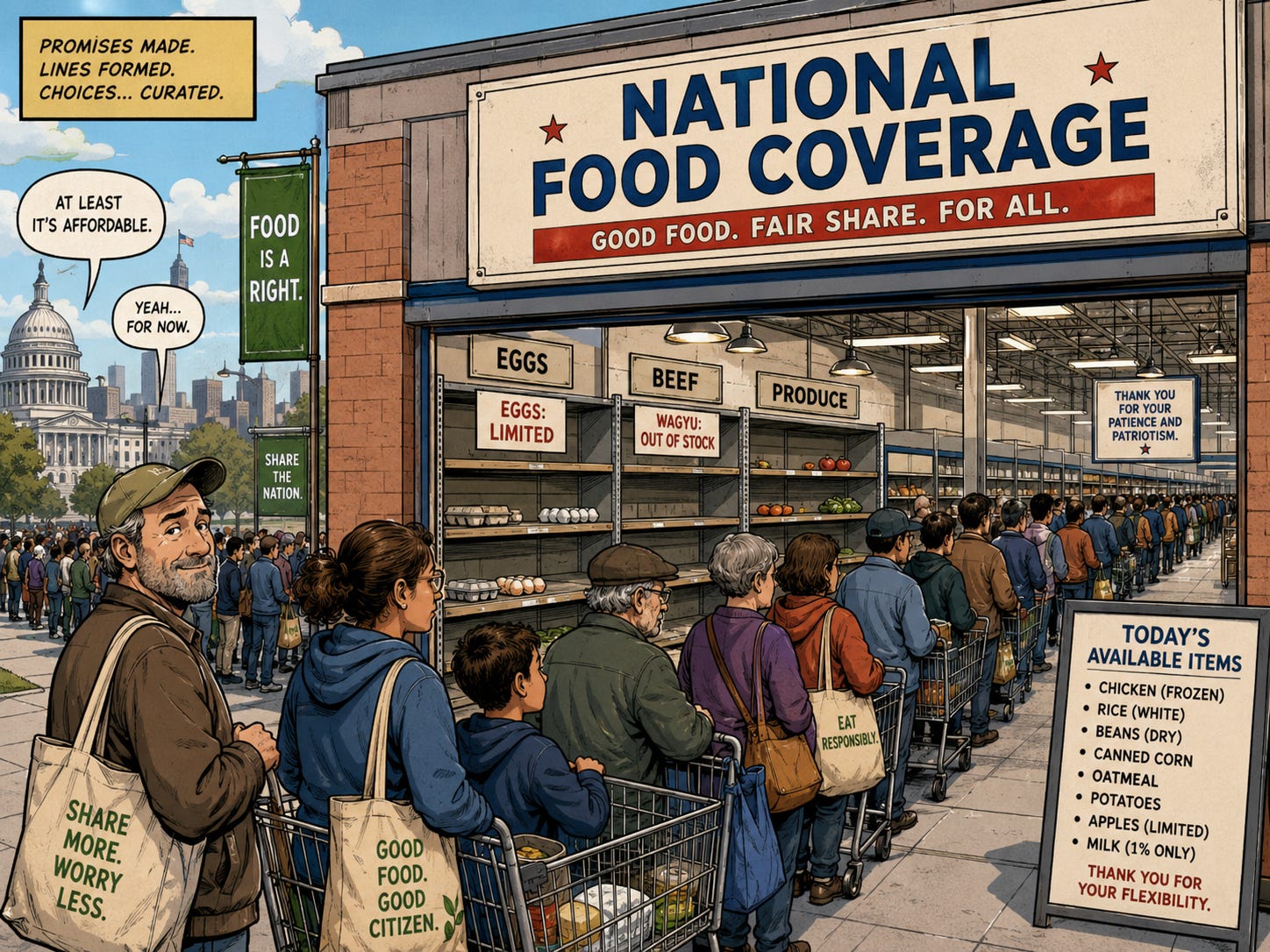
To see why, consider a hypothetical. Imagine Congress decides that food is an essential public good and that everyone should have food insurance.
Every American receives a food card. There are no premiums, deductibles, or copayments. You go to the grocery store, choose the food you want, and the federal government pays the bill. No one is denied food because they cannot afford it. Employers no longer need to offer food benefits. The system is universal, equitable, and administratively simple.
The federal government would understandably want to standardize how much it pays grocery stores. So it would create a national food reimbursement schedule. Apples would be reimbursed at one price, eggs at another, beef at another, and rice at another. Perhaps the government would adjust those rates for geography, season, transportation costs, and store size. It might create special bonuses for rural grocery stores or extra payments for fruits and vegetables.
If everything in the grocery store is free at the point of purchase, many people will select the Wagyu beef and organic free-range eggs. You would quickly see shortages of some items and surpluses of others. People who knew when shipments of the most desirable foods arrived, or who knew how to work the system, would get the best selection. Others, perhaps those with full-time jobs or busy home lives, would be left with whatever remained.
Price signals would be largely eliminated. But the system would also eliminate a great deal of administrative activity. Grocery chains would spend less time negotiating with suppliers. There would be less price competition among stores. Advertising might decline because consumers would no longer care as much about prices. Price transparency would disappear almost completely.
Stores might no longer need customer loyalty programs. Coupons would disappear. If the government adopted global budgets, it could make the system simpler still. Each grocery store would receive a fixed annual amount to feed its local population.
The administrative savings would be immense. But so would the food shortages.
A national board would have to determine the correct reimbursement for every product in every community. If it paid too much for beef, stores would stock too much beef and suppliers would redirect resources toward cattle production. Then bacon might become difficult to find. If it paid too little for eggs, eggs would disappear from shelves. If the national payment for avocados worked in California but did not cover transportation and spoilage in Alaska, stores in Alaska would stop carrying avocados.
People would be upset. Sure, the avocados are theoretically free, but what good is that if you cannot find one?
In response, the government would create a geographic adjustment, followed by a seasonal adjustment, followed by a rural access adjustment, followed by a quality bonus. Before long, the simple national food system would begin accumulating the same complexity it was designed to eliminate.
There is no single correct price for an egg. The price depends on hundreds of inputs, including feed, labor, and local demand. Those conditions change constantly. No committee in Washington can collect and process all of that information in real time. Markets do it imperfectly through millions of transactions.
We have seen how quickly the price of eggs can change over the past few years. When eggs become more expensive, consumers buy fewer of them, switch to other foods, or sacrifice spending elsewhere. Producers receive the signal to increase supply. None of this happens perfectly or instantaneously, but prices convey information that no central planner possesses.
Healthcare is much more complex than food. Its supply chains are more complicated, its services are more prone to asymmetric information, and its prices are far less transparent. Yet we imagine that a central administration can efficiently distribute healthcare resources when the same idea applied to food would seem laughably unrealistic.
The cost of treating pneumonia depends on the patient’s age, medical history, severity of illness, and dozens of other factors. A neurosurgical operation cannot be standardized like a box of cereal. Even two patients with the same diagnosis code may require completely different levels of judgment, time, technology, and postoperative care.
For physicians, Medicare assigns relative values to thousands of services and converts those values into dollar payments. For hospitals, it sorts admissions into diagnosis-related groups and pays a predetermined amount. For outpatient care, it uses another payment system. For drugs, devices, rehabilitation, home health, and nursing facilities, it uses still more administered prices.
When Medicare pays too much for a service, capital and physicians flow toward it. When Medicare pays too little, access contracts. The system then tries to repair the resulting distortions through a myriad of technocratic tweaks, for example, quality metrics. These corrections create more opportunities for lobbying, further distortions in the market, and additional administrative complexity.
We already complain that the United States has too few primary care physicians and too many highly paid procedural specialists. If pediatricians were paid like orthopedic surgeons, we would probably have more pediatricians. We might also have fewer orthopedic surgeons and longer waits for knee replacements.
The underlying problem is that no central authority knows the correct number of pediatricians, orthopedic surgeons, or operating rooms that each community needs. Even if it did, pediatricians, orthopedic surgeons, hospitals, device manufacturers, and every other organized interest would be trying to influence the bureaucrats making those decisions.
So how do other countries reduce their administrative costs? Famously, the United States covers fewer people at a much higher cost. Other countries constrain their budgets and use administratively simpler systems. They sacrifice responsiveness and efficient resource allocation in exchange for administrative simplicity.
Take the NHS. The government establishes a budget and allocates resources through the health service. Market price signals play a much smaller role in prompting the expansion of service lines and increases in capacity. If the budget does not support more infrastructure, those things do not get built.
The NHS currently has more than six million patients waiting for treatment, with more than 100,000 waiting over a year. The rationing mechanism is administratively simple: establish a budget and allow the queue to absorb the difference between demand and available capacity.
The result is patients opting back into the private market. About 12 percent of Britons now have private medical insurance, despite already paying taxes to support the NHS.
Canada provides a similar lesson. Provincial governments finance medically necessary hospital and physician services through public insurance, using hospital budgets and administered physician fees rather than relying primarily on prices to coordinate supply and demand. The result is relatively simple billing for the patient.
Yet when prices are prevented from directing additional capital and labor toward areas of shortage, waiting times grow. The median wait times in Canada are over a year for a neurosurgery consultation, 6 months for an MRI, and over a month for an ultrasound.
Canadians are also severely restricted in their ability to purchase private insurance for services covered by the public system. As a result, some travel abroad to obtain care. Approximately 50,000 Canadians leave the country for medical treatment in a typical year, often paying substantial out-of-pocket costs to do so.
In many countries with universal public systems, there is also substantial uptake of private health coverage. From the Nordic countries to Australia, these administratively “simple” systems often rely on private care to provide additional capacity, faster access, or greater choice. Nearly half of Australians have private hospital insurance, while more than half have some form of private general-treatment coverage.
The private sector keeps reappearing because administrative simplicity comes with less responsive resource allocation, just as it would under our universal food coverage example. No central planner can know the changing demand for hip replacements in North Dakota, how much it costs to keep a primary care clinic operating in Charleston.
This is the mistake in treating lower administrative spending as an unqualified measure of efficiency.
A global budget is easy to understand. The government gives a hospital a fixed amount of money and tells it to care for the population. There are fewer claims to adjudicate and fewer contracts to negotiate. But once the hospital reaches the limits of that budget, the remaining decisions do not go away. Someone must decide whether to add operating-room hours, or make the patients wait.
Those are allocation decisions. They carry real costs, even when those costs never appear on an administrative ledger.
This is why the National Food Insurance analogy matters. Congress could make paying for food administratively simple by creating one budget and one national price schedule. But once everyone could order whatever they wanted without seeing the price, demand would rise. The government would then have to decide how much beef, fruit, bread, and milk the country should produce and what each should cost.
If prices were not allowed to adjust, the adjustment would happen somewhere else. A waiting list would form. People with money would shop at a private store or drive across the border.
Healthcare is no different in that respect.
So yes, we could save a great deal of money by eliminating administrative waste. We could create one payment system, one national fee schedule, and one global budget. The paperwork might become much simpler.
But simplicity is not free. The cost would appear elsewhere: shortages, queues, and political lobbying, plus the additional cost of high taxes plus the out of pocket cost for those who exit the system.
Most Americans would not like that tradeoff.
You assume that universal coverage would expand demand. This was true when people went from no coverage to Medicaid. For a year and a half . Then their utilization normalized. Your assumption that demand needs to be controlled should be questioned. Most people don’t want to go to the doctor. The medical and pharmaceutical industries work hard to push demand.
If the pharmaceutical and medical industries offered quality appropriate care, demand would be about what it is now. The scarcity of access drives demand for a while. That’s the reason universal coverage makes sense.