
Your doctor is trying to order an MRI.
The reason almost doesn’t matter. Maybe there is concern for a brain tumor. Maybe a herniated disc is making you drag your foot. Maybe the diagnosis is still uncertain, and the MRI is supposed to help find it. The physician has decided that the scan is necessary.
That should be the hard part. It often isn’t.
At many hospitals, ordering an MRI is not one action but a chain of them. Select an indication from a dropdown menu. Type the indication again in a free-text box. Complete a metal-safety form. Enter a phone or pager number for urgent results. Attach a diagnosis code, even when the diagnosis is already in the note and elsewhere in the order.
In many systems, the order also opens a decision tree asking why the patient needs an MRI rather than a CT scan, an x-ray, or some other test. CMS paused its Medicare Appropriate Use Criteria program in 2024, but local utilization controls and old EHR configurations do not necessarily vanish when a federal rule does. A requirement can outlive the policy that helped create it.
Physicians learn the workarounds. Save the phone number in a favorite order. Copy the indication from the note. Pick the diagnosis code that makes the screen go away. None of these adaptations is dramatic enough to inspire a revolt. Each saves a few seconds. Together, they become the unofficial operating system of medical care.
The same thing happens elsewhere. A hospital decides that recurring daily laboratory orders encourage unnecessary testing, so it disables them. Physicians then create new routines to make sure necessary labs are ordered each morning. A critical result may generate a call from the laboratory, a second call from the nurse, and an electronic alert from the mobile EHR. Each notification has a defensible purpose. The cumulative system is absurd.
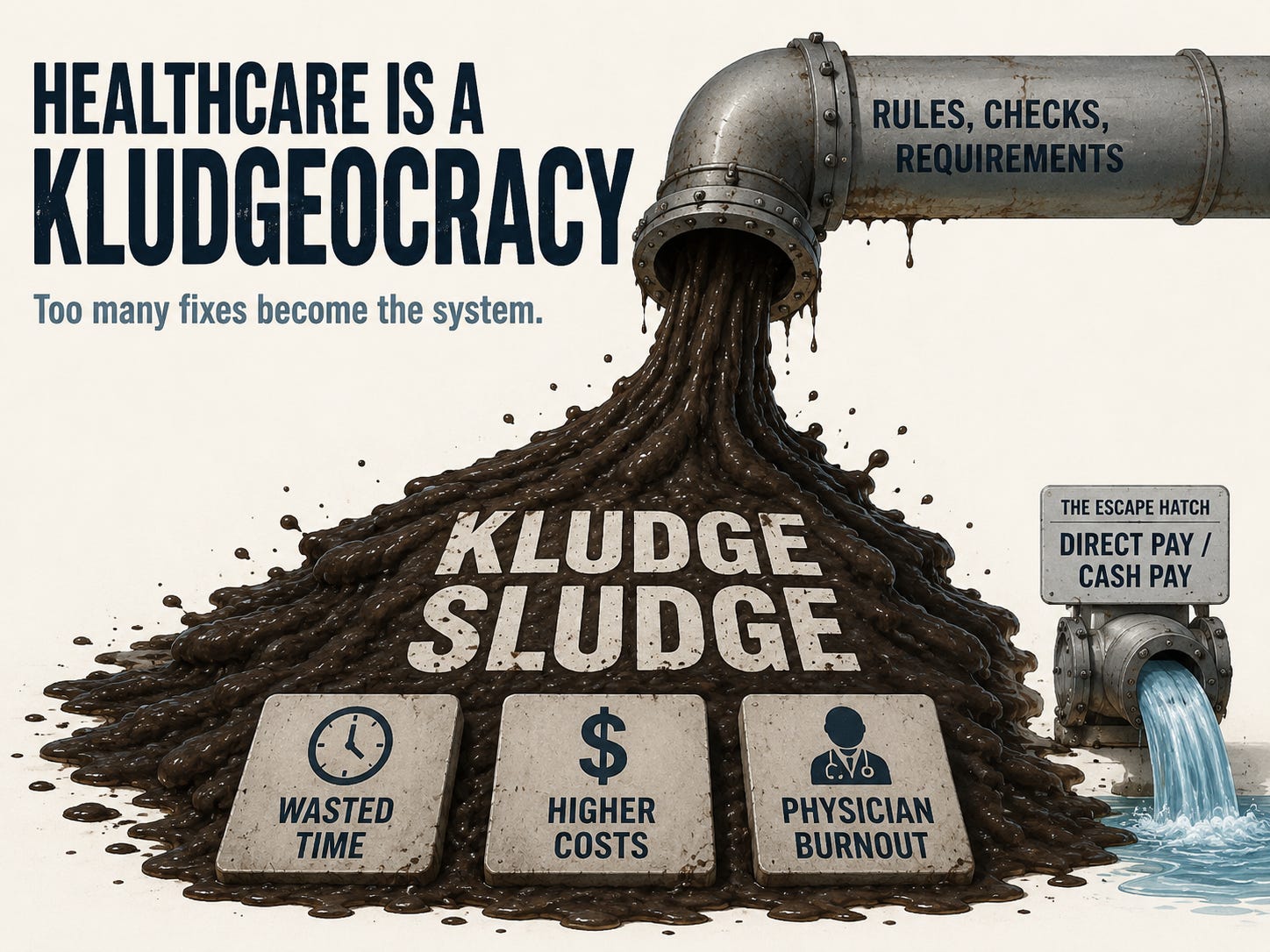
Political scientist Steven Teles gave this style of government a name in his 2013 essay “Kludgeocracy in America” (credit to Michael Zirwas, MD, who brought the term to my attention on X). A kludge is an improvised fix: something added because redesigning the underlying system is too difficult. A kludgeocracy is what happens when those fixes accumulate into the system itself. American policy becomes a stack of tax preferences, reporting systems, and indirect subsidies that no one would design from scratch.
That describes American health care perfectly
.
The rules did not appear from nowhere. Physicians sometimes order unnecessary tests. Imaging can expose patients to incidental findings and downstream procedures. Repeated laboratory testing can waste money and blood. Safety checks prevent real mistakes. Insurers, hospitals, and government programs have legitimate reasons to care about utilization, cost, and quality.
The problem is not that every rule is foolish. The problem is that almost every rule transfers its operating cost to someone else, usually the clinician and the patient.
Third-party payment makes this worse. When patients are insulated from the price of an MRI or a laboratory test, payers respond with utilization controls. But utilization control is not free. We hide the financial price from the clinical encounter, then reintroduce it as an administrative price.
A 2019 JAMA review estimated that administrative complexity accounted for $265.6 billion in annual waste. That figure is an estimate, and not every administrative task is wasteful, but the scale is difficult to dismiss. In the AMA’s latest prior-authorization survey, physicians and their staff reported handling about 40 requests per physician each week and spending roughly 13 hours on them. A time-and-motion study found that ambulatory physicians spent almost two hours on EHR and desk work for every hour of direct clinical face time, plus another one to two hours at night.
The burden does more than irritate doctors. It changes the structure of medicine.
In 2024, 42.2% of physicians worked in private practice, down from 60.1% in 2012. The AMA survey behind those figures identified inadequate payment, costly resources, and regulatory and administrative burdens as important reasons practices are sold. That does not prove that every dropdown menu causes a physician to sell to a hospital. It does show the direction of the pressure. A fixed compliance cost is easier for a large system to absorb than for a small independent practice.
The large system then builds an administrative and IT infrastructure to manage the rules. That infrastructure needs its own workflows, meetings, and safeguards. New people are hired to manage the old people who were hired to manage the original rule. The attempt to control costs creates a new category of costs.
This is the vicious cycle of health-care kludgeocracy: complexity creates work; work creates consolidation; consolidation creates distance between decisions and consequences; distance creates demands for more oversight; and oversight creates more complexity.
Cash-pay practices and direct primary care offer a partial escape. When the patient, physician, and price are close together, much of the billing machinery and prior-authorization apparatus can disappear. A cash transaction does not need permission from an insurer.
Before adding a new rule, the payer or hospital should answer three questions: Who will do the work? How much time will it take? What old requirement will be removed in exchange? Rules should automatically sunset unless their owners can show that they improve outcomes or reduce total cost. Whenever possible, the organization demanding the information should absorb the burden of collecting it rather than pushing another click onto the clinician.
No single reform will fix a system built from a thousand patches. But we can stop pretending that each patch is free.
American health care does not need another workaround. It needs, in medical terms, a kludgeectomy.
When you realize the federal (and most state) governments are kleptocracies, it all makes sense. The state of California, for example, gives free healthcare to illegal immigrants while passing a new tax to make health insurance more expensive for the rest of us. Meanwhile they are only one of two states (along with New Jersey) to tax Health Savings Accounts because god forbid we have some freedom to go outside the system.