
Milton Friedman described four ways people spend money. The most careful way is spending your own money on yourself. You care about quality, but you also care about price. The least disciplined version is spending someone else’s money on yourself. You still care very much about what you receive, but you become far less careful about what it costs.
That insight explains a great deal of American healthcare.
Every physician has heard the phrase: “Insurance will cover it.” It is usually said innocently. The patient is not being greedy. The doctor is not necessarily being wasteful. Both are responding to the incentives in front of them. If the price is hidden, if the bill is routed through a third party, and if the cost returns later through premiums and deductibles, then no one at the point of care is forced to ask the basic economic question: is this worth what it costs?
That question cannot be avoided forever. Scarcity does not disappear because something is covered. The cost is simply socialized among millions of taxpayers and premium payers. But someone still pays. The only question is whether the person receiving the service sees the price clearly enough to make a real tradeoff.
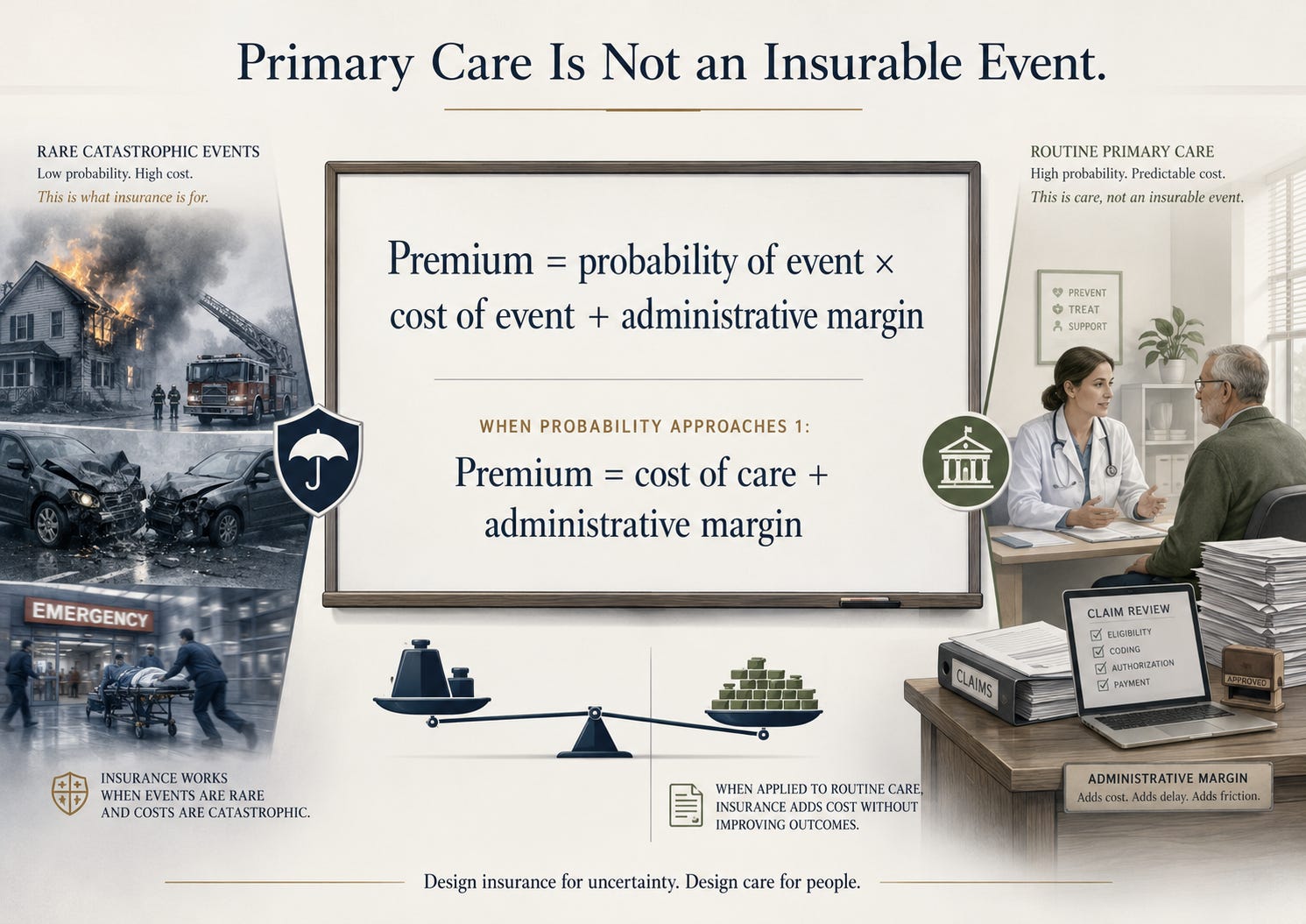
That brings us to insurance. When you pay for something with insurance, you are using money pooled from premium payers by the insurance company. Insurance works because it is a way to pool risk. In simplified form, the equation looks like this:
Premium = probability of event × cost of event + administrative margin
That formula works when the event is rare and financially devastating. A house fire is unlikely, but ruinous. A catastrophic car accident is unlikely, but expensive. These are the kinds of risks insurance was designed to handle. The probability is low, the cost is high, and the administrative margin is worth paying because the alternative is financial disaster.
This is why actuarial discipline matters. If an insurer overestimates the probability of an event, its product becomes overpriced and competitors undercut it. If it underestimates the probability, it pays out more than it collects and eventually fails. Markets punish bad math.
Routine medical care does not fit this model. Over a lifetime, the probability that a person will need ordinary medical care approaches 100 percent. That changes the equation.
Premium = cost of care + administrative margin
At that point, you are no longer buying insurance in the traditional sense. Millions of people are prepaying for expected consumption through a middleman. And the middleman must be paid. Applying an insurance margin to a predictable event guarantees that the total cost will be higher than the underlying service. But because the care is prepaid by millions of individuals, almost no one pays attention to the ultimate cost.
We understand this everywhere except healthcare.
We have confused health care with health insurance. We have routed predictable medical needs through a financing mechanism designed for rare catastrophes. We are spending someone else’s money on ourselves through an insurance structure built for events that are supposed to be unlikely. Friedman explains the behavior. The insurance formula explains the cost.
This is also why utilization management expands. Once routine care is paid for by a third party, demand rises because the visible price falls. But the real cost has not disappeared. It has only moved. So the payer has to regain control through utilization management, whether that means prior authorization, quality metrics, or compliance regimes like Stark Law. These are not random irritations. They are the rationing tools of a system that hides prices at the point of care.
None of this is free. Administrative spending in American healthcare is enormous, and every routine transaction routed through insurance adds another layer of billing, compliance, and adjudication. The bureaucracy is not incidental to the model. It is built into the price.
Patients experience this as madness. They pay premiums every month, often through wages they never see. Many are paying the insurance margin without receiving the practical benefit of insurance. They are insured against routine care but still exposed to routine costs.
The usual defense is that if patients pay directly for routine care, they will skip necessary treatment. There is truth in that concern, especially for poor and very sick patients. But it does not follow that every primary care interaction should be laundered through an insurance company. Helping vulnerable patients afford care is not the same thing as hiding the price of care from everyone.
A more honest system would restore insurance to its proper role. Health insurance should protect families from financial catastrophe. It should be there for the ICU stay, the cancer diagnosis, the premature birth, the trauma admission, and the kind of medical disaster no ordinary household can budget for. That is what insurance is good at. That is why insurance exists.
Routine care should look more like a normal market. Prices should be visible. Patients should have agency. Physicians should be accountable to the people they treat, not to a claims-processing bureaucracy.
Direct Primary Care is not a complete solution, but it shows what becomes possible when ordinary care is removed from the insurance machine. The patient pays a clear monthly fee. The physician does not bill a third party. The relationship becomes simpler, more direct, and more accountable.
The objection, of course, is that healthcare is special. And it is. A sick patient is not the same as a shopper buying tires. No serious physician believes medicine can be reduced entirely to retail economics.
But healthcare being special does not make it immune to tradeoffs and costs. The tragedy of American healthcare is that we tried to make care affordable by hiding prices, and in doing so made care less affordable.
Insurance is necessary. Catastrophic coverage is essential. No civilized society should be indifferent to a family bankrupted by serious illness. But that is precisely why insurance should be reserved for what insurance does well. When we use it to finance everything, we make it worse at protecting us from the things that truly matter.
Primary care is not a catastrophic event. It is the ordinary maintenance of human life. Treating it like an insurable catastrophe has distorted prices, buried physicians in bureaucracy, and trained patients to believe care is affordable only when the cost is hidden from them.
And when the cost is hidden, we are back to Friedman. We are spending someone else’s money on ourselves. We are doing it through an insurance mechanism designed to price rare, expensive events. But routine care is not rare. The probability is effectively one.
Once you understand that, the equation becomes hard to ignore:
Premium = cost of care + administrative margin
That is not insurance. That is prepaid bureaucracy.
Sometimes the most radical healthcare reform is just arithmetic.
Primary care doesn’t take up much expense, any actuary will tell you. Most plans will try to make it practically free because if going to your check up prevents a hospitalization 0.000001% of the time that still pencils out as a money saver.
The major expenditures are hospitals, end of life care, and chronic conditions.
To the extent that higher cost shares cause people not to go to the hospital and their not going to the hospital doesn’t cause a larger health problem to develop they can save money.
I don’t see what we can do about end of life care because they just end up on Medicaid.