
The CEO of Kaiser Permanente makes nearly $13 million a year. Every physician and nurse sees the bureaucracy in their hospital and feels frustration. The hospital has a vice president for everything. There are executives whose compensation packages can feel almost obscene when physicians are spending their evenings arguing with a coding integrity officer instead of taking care of patients.
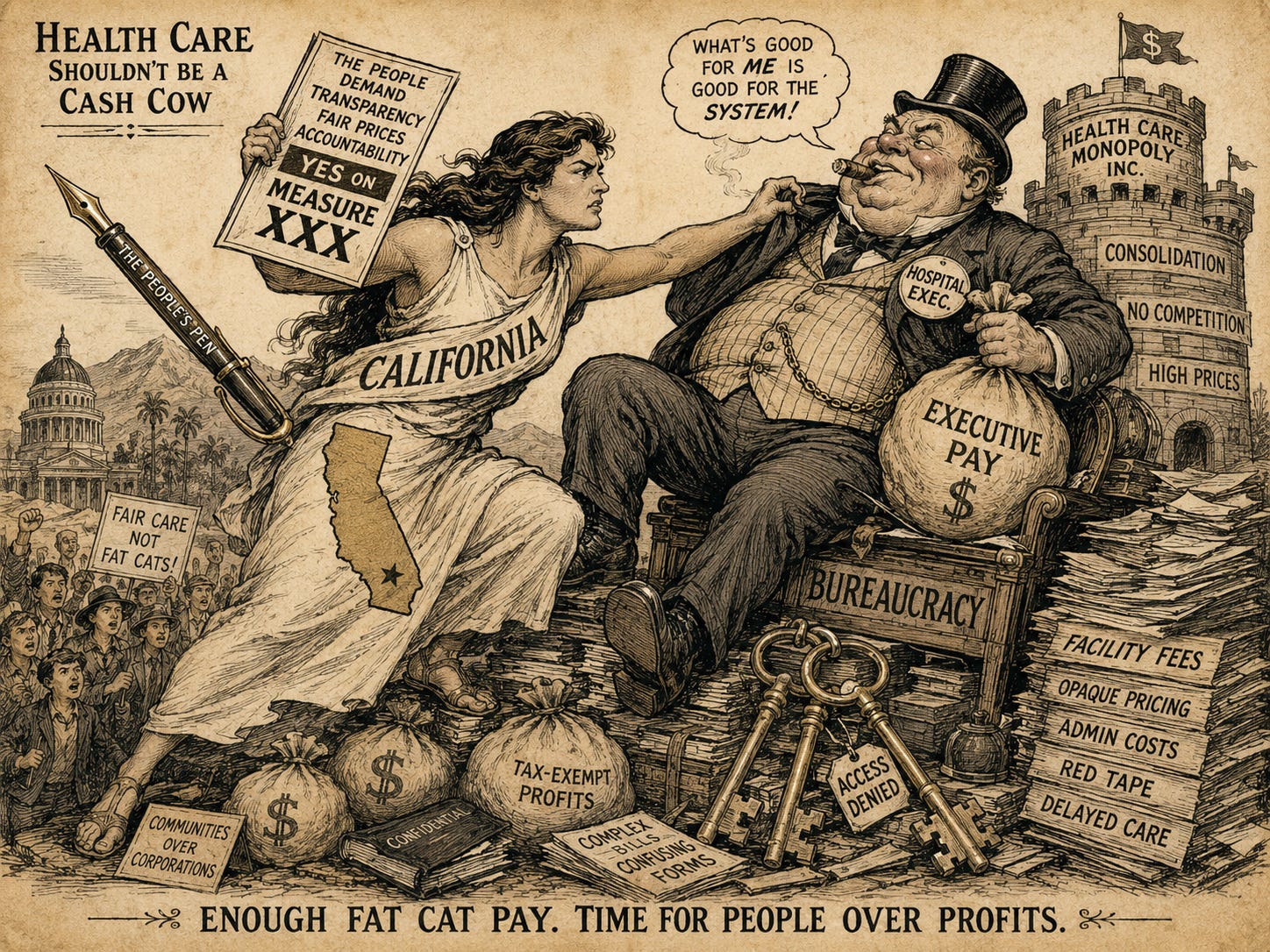
So it’s understandable to feel a little spiteful joy when California physicians see a ballot measure aimed at capping hospital executive pay.
The proposal, now eligible for the November 2026 ballot, would limit compensation for certain health care executives, managers, and administrators to $450,000 per year in total annual compensation. This includes salary, bonuses, stock options, company vehicles, paid time off, and other benefits. Even a parking space could count toward compensation.
It would also restrict severance above that amount, require annual reporting, and allow enforcement by the Attorney General or taxpayer litigation. The cap would rise annually by the lesser of inflation or 3.5 percent. The measure applies to covered hospitals and medical entities, including nonprofit and for-profit hospitals and some medical groups.
The political appeal is obvious. SEIU-UHW, which is backing the measure, argues that excessive executive pay should be redirected toward patient care, staffing, and lower costs. That message is not hard to sell for the populists among us.
I understand the temptation to cheer. I have spent enough time inside hospitals to know that the resentment is not imaginary. It is not crazy for a burned-out doctor to look at an eight-figure executive compensation package and feel moral disgust.
But that doesn’t fix the economics.
A wage cap is a price control on labor. That does not stop being true because the labor belongs to executives rather than nurses or physicians. Economists have shown for generations that price controls distort the signals that help allocate scarce resources. Price ceilings do not eliminate demand; they change how demand is satisfied.
That is the first problem with the California proposal. It assumes that if a hospital board is prohibited from paying a chief executive more than $450,000, they’ll retain the same executive talent and the excess money will simply flow to bedside care. That is possible in a narrow accounting sense, but it is not how complex organizations behave. If a large health system believes it needs a certain type of managerial skill, it will still seek those things. It may call them something else. It may outsource them. It may pay for them through consulting contracts, management services agreements, affiliated entities, deferred compensation, perks, or layers of subordinate executives.
Hospitals are incredibly complex organizations. I’ve long argued we should simplify many of the rules, but for now the rules are there, and it requires a specific skill set to navigate them. It also requires someone willing to work long-hours, making politically impactful, uncomfortable decisions. A hospital that cannot legally pay one competent executive the market-clearing rate may hire multiple vice presidents, consultants, contractors, and compliance specialists to divide the same work across titles. The measure’s drafters appear aware of this risk, which is why the compensation definition is broad and why the proposal reaches some contractors and subcontractors who exercise executive, managerial, or administrative authority. But that only illustrates the point. Once policy tries to centrally define and police the price of managerial work, the game shifts. The hospital does not become simpler. The compliance apparatus becomes larger.
This matters because administrative bloat is already one of the defining features of American medicine. California alone had an estimated 57,310 medical and health services managers in 2023, according to federal occupational data, though that category is narrower than the full universe of health care administrators, compliance staff, billing personnel, and managerial employees.
Meanwhile, the California Medical Association has come out strongly against the proposal, warning that it could affect physicians, nurses, and health care leaders who take on administrative, training, or leadership roles, and could destabilize access to care. As someone who wants more sites able to deliver care, including independent physician-owned hospitals, ASCs, and practices, I don’t like the idea of more compliance. These rules will harm physician-owned facilities and practices more than the large corporations. Large corporations have teams of lawyers to navigate complex rules. The independent neurosurgery practice does not.
High hospital executive pay is not the root cause of American health care dysfunction. It is one expression of a politically protected system in which enormous sums flow through opaque institutions that consumers cannot easily discipline. Hospital prices are not high because the CEO’s salary appears on a tax filing. They are high because hospital systems have acquired market power and because there is more money to be made in gaming various governmental revenue streams than there is in delivering a good product.
The evidence on consolidation is not subtle. KFF has summarized a large body of research finding that hospital consolidation tends to raise prices, with stronger evidence for price effects than for quality improvement. KFF has also found that one or two health systems controlled the entire market for inpatient hospital care in nearly half of metropolitan areas in 2024. GAO reported that hospital-physician consolidation has risen substantially and is generally associated with increased spending and prices, while the evidence for improved quality is weak or mixed. RAND’s hospital price work found that private insurers and employers paid, on average, 254 percent of Medicare rates for the same services in 2022, with hospital market power helping explain some of the variation.
California health care spending reached roughly $405 billion in 2020, according to the state’s Office of Health Care Affordability. National health expenditures reached $5.3 trillion in 2024, with hospital care remaining one of the largest categories of spending. Against numbers of that scale, executive compensation may be politically inflammatory but still fiscally small. That does not mean it is virtuous. It means we should be honest about magnitude.
There is also a historical warning here. In 1993, Congress tried to restrain executive pay by limiting the corporate tax deduction for compensation above $1 million for certain top executives, while leaving an exception for performance-based pay such as stock options. The predictable result was not an age of executive modesty. Compensation shifted in form. Stock options and performance-linked pay became a much larger part of executive compensation, and some researchers have argued that the $1 million limit effectively became a target for base pay rather than a ceiling on total compensation.
That is the recurring pattern of price controls. Politicians cap the visible number. Markets and institutions migrate to the less visible channel. Somehow the bureaucracy always survives the reform.
None of this excuses hospital executives. Many of them are rent-seekers in the plainest sense of the term. They operate inside institutions that have become expert at extracting revenue from complexity. Some of these leaders talk the language of mission while presiding over systems that sue patients and demand public subsidies. The anger aimed at them is not irrational.
A salary cap feels satisfying because it gives the public a villain and then symbolically punishes him. But good policy has to do more than satisfy resentment. It has to improve incentives. A hospital executive pay cap risks doing the opposite. It leaves the consolidated hospital system in place because large systems have the compliance infrastructure to deal with the new rules. Meanwhile, we haven’t touched site neutrality, 340B, and a host of other policies that drive consolidation in the first place.
Physicians should be especially wary of this kind of populism. The moral impulse behind this measure is understandable. The economic logic is not. A wage cap treats the visible irritation while leaving the pathology untouched. If California wants to make health care less expensive and more humane, it should go after the structures that made hospital executives so powerful in the first place.
Haha, this is a great nuanced take! I laugh because I would have expected you to take the populist position based on the title, but this was a very thoughtful understanding on capping hospital exec compensation. And yes, there are so many internal fiefdoms that the political dynamics become so oppositional that it requires strong political operators to navigate.
My hot take: you couldn't pay me any amount of salary to be a hospital exec, which I think is one of the most morally-precarious and politically-challenging jobs, while simultaneously being something where the measures of success are impossible to meet (omg another HEDIS quality score or patient satisfaction metric). It is the worst job for people doing the worst job.
This was a fiery post (as yours usually are), but I love the balance of cynicism with deep understanding. Keep up the great work!
I am very conflicted with this law. On one hand, I completely agree with you, and that this will end up backfiring.
On the other hand, the system has continually put price caps on physician compensation to save healthcare costs. There is a little spark in me that thinks that maybe, just maybe, the execs who lobby for price caps on physician compensation will end up fighting to remove price caps in healthcare and then we can work together towards real reform.
A doc can dream of a better future where we can just focus on caring for people, instead of completing paperwork.